Showing posts with label physics. Show all posts

Monday, August 17, 2026

DFG Heisenberg post-mortem, part 2

This post contains remaining parts of my DFG Heisenberg grant final report, by now long submitted and accepted by the DFG. I hope it will be of use, in particular to future DFG grant candidates. The text also somewhat explains why I'm fed up with academia, Regensburg, and physics right now (in no particular order and to varying degrees). The first part of the report can be found in a previous post. Some personal information has been redacted.

Qualification, career, …

During the Heisenberg period 2021-2026, submitted applications for professorships resulted in 8 invitations for presentation and discussion: [...]

A recurrent topic over all my years in academia was that appointment procedures for professorships either failed or that positions were handed to local Emmy Noether, Heisenberg, Juniorprofessor, etc. candidates – much more than expected from past times when the spectre of unwanted “Hausberufung” (in-house appointment) was looming over such events. From that point of view it was equally disappointing that, once I applied for a position in Regensburg, I was immediately told by a member of the appointment commission that my application would be sorted out for exactly that reason. When I spoke to an external member of the appointment commission for that professorship, that external member did not even know that I had applied for the position. In parallel, somewhat doubtful direct appointments to professorships took place in the department.

Further frustration originated from the fact that the Regensburg physics department decided to rewrite their internal regulations such that even after 6 years of Privatdozentur (senior lecturer with habilitation) they only award the title of Außerordentlicher Professor (associated professor, a title without salary) to candidates with a permanent university position. My corresponding petition never received any written response, only oral comment that this is not done anymore. The motivation behind all this is unclear, but it certainly does not make Regensburg more attractive to (somewhat) junior scientists.

A four-eyes career conversation with Mr. Dean of the Faculty resulted in charming comments such as “the best we can do is half an E13 position in the experimental collection maintenance of the undergraduate lectures in a year or so, maybe you could do some research on the side there” and “as a Heisenberg you are an academic legacy problem” (the original German term was “akademische Altlast”). Plus remarks like “we are not going to hand out any (even unpaid) teaching assignments (“Lehraufträge”) to an external Privatdozent anymore, so you’ll lose that title anyway soon for lack of teaching.”

The final cherry on top was then getting berated by another influential senior faculty member about producing insufficient results and being unable to supervise – which is pretty thick coming from someone who barely finds any MSc students, having a reputation among students for erratic grading there. To quote a colleague from Regensburg with permanent employment who should probably stay anonymous, “Der professorale Dünkel ist stark in der Fakultät” (roughly translated, the professorial sense of self-importance is tantamount in the department).

With all these experiences as background, I strongly recommend to anyone with a grant such as DFG Emmy Noether or Heisenberg not to join the Regensburg physics department, but go somewhere else. You and your work will be valued more, and that by far compensates for any Regensburg “excellence”. [...]

Teaching and scientific events

With already significant teaching experience, I decided to mostly focus on research and supervision during the Heisenberg period – with the exception of a “Low Temperature Physics” course where the usual lecturer was on sabbatical. Regarding scientific events, I had requested a moderate amount of funding for a workshop on inorganic nanotubes in [...], which would have fitted quite well as add-on to the workshops of SFB 1277. This was however declined – accordingly, it also did not have priority for me anymore either.

Perspective

I enjoyed university research and teaching as well as working with students, establishing a research group, quantum device fabrication, and complex measurements very much. With the “orderly shutdown” of the group comes that still some students need to graduate and that some results will still be written up and submitted for publication (at the time of this report two papers have been submitted and another two or three might follow); however, I have cleared out my office the day of the end of my employment contract. 

Out of a certain stubbornness, I will keep teaching my 2SWS per year Titellehre for now – as confirmed by the faculty administration, a teaching appointment (“Lehrauftrag”) is legally not required for that, and as a consequence the students will be treated to a block course “How to write a thesis, present a talk, …” in October. However, after over 15 years in Regensburg I have learned that being nice, friendly, cooperative, and helpful might get you friendly smiles and occasional money there but not any sustainable support, and that the Regensburg physics system prefers “junior scientists” to be subordinates, not colleagues. Of course someone who does not have the visible backing of his current university immediately also has a weaker position when applying elsewhere. 

There’s a lot more I could write, but that would go beyond scope and purpose of this report. Anyway, it is now time to make a bonfire out of lecture notes, to go out into the wide world, and to do something entirely new. Which, barring big surprises, most likely will not involve physics or a university anymore. 

Thanks to Duong Thi Hai Yen on vecteezy.com for the tomato.

Monday, July 20, 2026

DFG Heisenberg project post-mortem

This post is an excerpt from the formally non-public part of my DFG Heisenberg grant final report (about half of the actually interesting part). I hope it will help people do better. The remaining part of the report can be found in a subsequent blog post. Some personal information has been redacted.

The backstory

In 2018, when I first submitted a Heisenberg program proposal, funding was declined. One referee report was full of misinformation and misinterpretations, the other criticized the methods in one of the suggested research subtopics. Overall this sufficiently lowered the ranking of the entire submission. Anyway, as the saying goes, stand up again, brush down coat, re-adjust crown, keep going. The proposal was updated, the doubtful part replaced, a response to the misinformation added, and of course also some more exciting research ideas included.

At that point I decided to go for full risk. While the DFG Emmy Noether program deliberately funds a junior research group consisting of a PI and PhD students or a post-doc, the DFG Heisenberg program is more adjusted along the customs of humanities and funds the PI alone. It is still supposed to provide a base for independent research at the level of associate professor though, which is why one can concurrently submit a supporting research grant proposal for equipment and personnel. The advantage of doing so is that this can form a coherent overall funding package, the disadvantage is that a negative review of any part of the package will drag it down in its entirety, see above.

Complementing the overarching Heisenberg proposal for my own position and its research, I submitted in 2019 two additional research proposals ("Einzelanträge"). One focused on the continuation of the Emmy Noether project, tuning optomechanics of single-wall carbon nanotubes towards strong coupling and coherent control, and including such nice ideas as, e.g., coupling mechanics with coherent states in double quantum dots. This was a highly complex project, intended for two PhD students (and the two students were really required because of the combination of multi-step fabrication and complicated experiment). In addition, it was adjusted to fit to the topic of a Graduate Research School (GRK) proposal under preparation back then in Regensburg. The idea of the second grant was to try out something new, and establish quantum transport measurements on MoS2 nanotubes – a material where already a lot of optical measurements existed but the transport physics of quantum dots was so far completely unexplored. Here, one PhD student was requested; furthermore the topic was deliberately chosen to be in the area of interest of a new Regensburg Collaborative Research Centre (SFB), SFB 1277, in the hope of further financial support options.

Because of the significant amount of university-bound equipment acquired from SFB funds, and the potential difficulties of moving “my” large dilution refrigerator, I chose again Universität Regensburg as host institution.

In the meantime, my employment contract in Regensburg ran out (thanks Wissenschaftszeitvertragsgesetz), so I went to the Low Temperature Laboratory, Department of Applied Physics, Aalto University, Finland for one year as full-time employed visiting professor; my thanks go to Prof. Pertti Hakonen for making this possible. Two weeks later COVID broke out, but Aalto was a great place to be both scientifically and to sit out the pandemic. And in autumn a sequence of excellent news followed; the Heisenberg grant was approved, and in addition the Emmy Noether work on microwave optomechanics was awarded the Walter Schottky Prize 2021 of the German Physical Society. So, things were clearly brightening up, or so I thought.

A more detailed inspection of the grant approval letter provided a somewhat more mixed image. One referee explicitly and clearly supported the request for two PhD students in the optomechanics project, the other also explicitly lauded all details, including the excellent funding plan, of the optomechanics project, but additionally stated that the impact of the MoS2 nanotube project would be larger (this was likely written before the announcement of the Walter Schottky Prize). As result, only one PhD position for optomechanics was granted by the funding committee. Hope always dies last, but in retrospect I can now confirm my immediate suspicion that this reduction of funding killed the optomechanics project from the start. My initial “plan B” for additional optomechanics funds was not available anymore, since the Regensburg Graduate Research School had in the meantime made an ultrafast turn towards other research topics. Further, even though this project was the direct continuation of the Walter Schottky Prize work, it turned out to be extremely difficult to find and hire a PhD student for it. The project started on 16 March 2021, and only on 1 August 2022 a PhD student arrived.

In comparison, the MoS2 nanotube project start-up went much more smooth, and [...] started work on his PhD straight on the 16 March 2021. All hope of a financially significant participation in the Regensburg SFB 1277 was however shattered already by a brief conversation with the back then SFB speaker, who made clear that nothing beyond appointing me “associated member” would even be considered. Well, you can't allow “junior scientists” to become too successful…

Scientific progress

I had attempted to keep the optomechanics project going in Regensburg during my time in Finland via a remotely-supervised MSc student, who successfully optimized coplanar waveguide resonator geometries and produced and tested the corresponding devices. When I came back, I quickly found another MSc student who was very enthusiastic to start with optomechanics experiments. However, we also quickly found out that the nanotube growth oven had broken in the meantime, requiring the whole process to be optimized from the start, and the MSc project literally became a year of getting carbon nanotube growth going again from zero. Now in 2026 (!) the quality of nanotubes transferred into a circuit is finally showing excellent results again. That said, the nanotube optomechanics project had many delicate parts, from nanotube growth and transfer to coplanar resonator chip design and fabrication, and no number of MSc students recruited into my group could really replace the missing second PhD student.

[...] On the MoS2 nanotube side, progress was slow but steady, and the PhD student did excellent work. Making contacts to MoS2 nanotubes turned out to be even more complex than contacts to carbon nanotubes or a 2D MoS2 monolayer. A technical breakthrough in the latter system by researchers from MIT and TSMC, among others, provided a path forward, and indeed their approach also led to occasional good results with the MoS2 nanotubes. Obtaining these good results reproducibly, however, was again another complex optimization step; we solved that in 2025 and subsequently managed first physically interesting low-temperature measurements.

In general, across both subprojects, work was slowed down very much by continuous equipment break-downs and oddities in the Regensburg cleanroom. "The SEM for e-beam writing is down" turned out to be one highly regular e-mail subject (for any possible value of "the SEM"). Mystery changes in resist properties, micrometer-scale shifts in the written structures, interruptions in the air conditioning that led to water condensation in the whole cleanroom, ... The department bought a Heidelberg Instruments mask-less aligner (a laser writer for lithography), which was nice but of limited usefulness – since for nanophysics you actually need nano-resolution! Plus there were some other annoying events; e.g., during the installation of a new dilution refrigerator next door someone opened up our (then evacuated) 3He/4He circuit in the pump room to air, which we only noticed when we tried to cool down and suddenly were pumping air into the cold dilution refrigerator insert. Luckily, nearly no isotope mixture was lost.

Experimental work took significantly longer than expected, but eventually did yield interesting results right at the end. As stated above, for the research details of the two subprojects, I refer to the final reports of the research grants [...] and [...].

[...]

Early career stage researchers

I am proud to be able to say that during my ~16 years in Regensburg I have supervised 7 PhD students and 27 MSc or Diplom students. During the Heisenberg period specifically, two PhD students should be named, [...] and [...]. [...] is currently helping a new professor in Regensburg build up his lab on a post-doc position and considering remaining in academia (which he would definitely be suited for). [...] is still busy measuring beautiful data and writing up his dissertation, while being paid by SFB1277.

At the end of the official project runtime (and my employment) in March three MSc students were still active; two have graduated by now, the third one recently handed in his thesis.

Wednesday, September 18, 2024

Rating scientific (or not so much) conferences

If you work in research, nowadays you can be sure to get swamped with "conference invitation" e-mails. A large part of these is, in effect, spam - attempts to get you (or your funders) to pay for meetings of highly questionable scientific worth.

So, let's introduce a rating scale for scientific (or not) conferences, from 0 to 10. All examples have really happened.

0 - Trash

  • You ask a friend who is listed in the organizing committee, and get the response "what conference?"
  • Advertising mostly mentions the location (Maledives!) and the proceedings (Indexed by Google Scholar!)
  • You arrive at the location and there is no conference.
  • If there is one, you can barely find it because it's in the back room of some hotel conference center.
  • Instead of a conference organizer's desk you encounter a pile of badges and participation certificates.
  • The "hybrid session" consists of you, the AV technician, and some poor guy on zoom talking to a non-existing audience.
  • There's a talk on the "memory of water".
  • A remote talk is given by someone in a car while driving.
  • There are less posters than talks.

3 - We do this for the money, but hey, we're trying!

  • The conference organizing committee contains the one or two well-known professors who are in every organizing committee. Everyone else is from countries you've never heard of.
  • The meeting has taken place before and the website is somewhat professional.
  • The conference secretary is called Elsa, Belle, or Jasmine and sends you an e-mail every week, offering an invited talk for a "small reduction" of the conference fee (hint, the size of the reduction can be up to negotiation!)
  • Between sign-up and actual conference date, the number of days and sessions mysteriously shrinks.
  • The conference organizer's desk is handled by a bunch of undergrads who barely speak English and have no clue.
  • The welcome address is skipped since the speaker doesn't turn up. Same for the chairman of the first session. After the first regular speaker starts their talk, the chairman hurries in - "sorry, sorry, I ended up at the wrong conference..."
  • You meet a few colleagues from home who find the situation similarly amusing as you, and have a good time at lunch.
  • Eventually things become somewhat more regular, and sessions and talks take place, but you have quite some doubts about the scientific quality of some of them.
  • Focus? What focus?

6 - Yes I'm gonna establish a conference, mark my words!

  • 5th or 6th installment of a conference series, typically by the same scientific organizer or organization.
  • You find the conference without problems, and there is actually a well-organized conference desk. Maybe even the scientific organizer greets you in person.
  • The location is only moderately flashy, function starts to gain over form.
  • Most of the participants are from serious scientific institutions and present work that can be interesting.
  • Main problem is still the focus - the topics are too broad, the number of participants too small, such that it's not so likely you will meet someone whose work is really relevant to your own.
  • If the main organizer has a good hand, they will accumulate a circle of regular participants and the event will grow over time.
  • Can, e.g., be a professor establishing an international conference on their topic in their home country...
  • Typically 2-3 companies are present trying to sell their lab supplies.

9 - Congratulations, it's a great scientific conference

  • Either wide focus and a huge number of participants, or narrow focus and a small number of participants
  • Organized by a scientific society (DPG, EPS, APS, ...) or by a group of internationally well-known experts in one specific field
  • True invited talks are comparatively rare, and come with (depending on the financial situation of the host) either no reduction of fees at all, or even funding of travel expenses.
  • You know nearly everyone in the organizing committee, at least from their publications.
  • Many more poster contributions than talks.
  • You can be sure to meet many of your scientific colleagues.
  • Large commercial presence of companies sponsoring the meeting and advertising their high-tech equipment.

10 - Summa cum laude

  • Small meetings organized by few top experts of a research area, or (very rare) large meetings consisting of several such high-quality sessions in combination.
  • Organized by top level scientists in the field worldwide
  • Participation by invitation only, true selection of conference participants (more applicants than places)
  • In some cases, even free participation and accommodation
  • Recent examples: Gordon Research Conferences, Heraeus seminars, the QuantuMatter 2024, ... 
 Thoughs?


Monday, October 30, 2023

Lab::Measurement 3.900 released - also dropping support for legacy scripts

Following a lot of smaller and larger improvements and additions, we have finally released Lab::Measurement 3.900 on CPAN. Highlights compared to the last "round version" include support for the Nanonis Tramea quantum transport measurement, the Zurich Instruments HDAWG arbitrary waveform generator, the Synktek MCL1-540 lock-in amplifier, the Bluefors dilution refrigerator temperature control, the American Magnetics AMI430 magnet power supply, as well as many improvements for Lakeshore temperature controllers.

In addition, version 3.900 now finally drops the unmaintained legacy code layers (Lab::Bus, Lab::Connection, Lab::Instrument, Lab::XPRESS) and focuses on the Moose-based Modern Perl interface alone. This should make maintenance easier in the future. Anyone who still needs the old interfaces for measurement scripts should install the distribution Lab::Measurement::Legacy, where the deprecated modules are archived.

Tuesday, January 10, 2023

Advanced Materials published: "Non-destructive low-temperature contacts to MoS2 nanoribbon and nanotube quantum dots"

Molybdenum disulfide MoS2 is often discussed as a groundbreaking material for electronics applications. As bulk crystal or as 2D layer material similar to graphene, it is an excellent semiconductor with strong spin-orbit interaction. At strong doping it even becomes intrinsically superconducting, with possibly interesting topological properties.

So how about using MoS2 for quantum electronics, single electron devices, or (charge, spin, or valley) qubits? There's already enough science fiction literature out there mentioning "molycircuits"... Well, a small problem stands in the way.  It turns out that the electronic band structure of the material makes reaching quantum confinement, i.e., discrete, addressable electronic quantum states, quite hard. The chip structures need to be built at very small scale, difficult to reach with MoS2 flakes on a chip surface, and so far no research group has managed to do this in a controlled way.

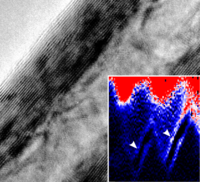
That's exactly why we are interested in MoS2 nanotubes. They can be grown clean and straight, with diameters down to 20nm - which automatically confines charge carriers in one more direction compared to a two-dimensional MoS2 flake. What remains is to restrict motion of the charge carriers along the nanotube axis and to make good metallic contacts. However, it turns out that making good contacts to MoS2 is hard - either your metals form a Schottky barrier, or they react with the MoS2 and destroy its crystal structure.

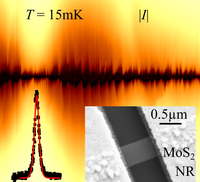
In our work, we show that this problem has now been solved. Using a thin layer of the semimetal bismuth, we obtain contacts which remain transparent even at cryogenic (millikelvin) temperatures and leave the structure of MoS2 below and next to them intact. This makes transport spectroscopy measurements on a MoS2 quantum dot forming within the nanotube possible. We indeed observe quantum dot behaviour; the temperature dependence of the Coulomb oscillations of conductance indicates that we reach electronic tunneling through single, discrete quantum states below a temperature of T=100mK. 

With this, we have made a big step towards controllable charge, spin, or even valley quantum states in MoS2. Next we need to miniaturize our devices even further, and increase our measurement resolution to be able to analyze the electronic level spectrum in magnetic fields.

"Non-destructive low-temperature contacts to MoS2 nanoribbon and nanotube quantum dots"
R. T. K. Schock, J. Neuwald, W. Möckel, M. Kronseder, L. Pirker, M. Remskar, and A. K. Hüttel
accepted for publication by Advanced Materials (doi:10.1002/adma.202209333); arXiv:2209.15515 (PDF, supplementary information)

Monday, October 24, 2022

Video from Walter Schottky Prize award ceremony now online

 The video recording of the Walter Schottky Prize award ceremony in June is finally online. Enjoy :)


Monday, October 19, 2020

PRB published: "Magnetic field control of the Franck-Condon coupling of few-electron quantum states"

The second-lowest vibration mode of carbon nanotubes is the so-called longitudinal or stretching mode; here the vibrational direction is along the axis of the carbon nanotube. The vibration frequency f and with it the harmonic oscillator quantum hf is already much higher than for the transversal motion; it scales with the length L of the vibrating nanotube segment as 1/L, and is for 100nm < L < 1000nm in the range 0.1meV < hf < 1meV.

With such a large frequency, the harmonic oscillator is at typical dilution refrigerator temperatures T < 100mK fully quantized. The mechanics now becomes visible in the transport spectrum of the quantum dot within the carbon nanotube as so-called Franck-Condon sidebands: For current to pass through the nanotube, an electron has to tunnel onto the quantum dot and then off it again. In our nanomechanical system, however, the mechanical equilibrium position depends on the electrostatic forces on the nanotube, and thus on the charge on it - the equilibrium position for N electrons is different from the one for N+1 electrons. This means that tunneling in is suppressed by a geometric factor describing this coupling, i.e., the limited overlap between the macromolecule wavefunction in both situations. If we provide enough energy to reach excited vibrational states, this suppression is partially lifted. Thus, as function of applied bias voltage, we see a series of steps in the current or lines in the differential conductance.

In our article, we demonstrate for the first time Franck-Condon sidebands in a clean carbon nanotube quantum dot with known absolute number of trapped electrons. We evaluate the coupling parameter and see that it depends on a magnetic field, but also on the precise electronic state that the electrons tunnel through. The so-called valley quantum number turns out to be crucial here; it is related to the angular momentum of the electron. Comparing our evaluation results with our previous calculations on the distribution of electrons along the nanotube axis, we propose a model that describes the coupling parameter as function of magnetic field for different quantum states. While the model is a simplification, it nevertheless is clearly able to qualitatively reproduce our experimental results of a tunable electron-vibron coupling.

"Magnetic field control of the Franck-Condon coupling of few-electron quantum states"
P. L. Stiller, A. Dirnaichner, D. R. Schmid, and A. K. Hüttel
Physical Review B 102, 115408 (2020); arXiv:1812.02657 (PDF)

Top Alexander von Humboldt foundation ranking for Regensburg University

After the top position in the Nature Index 2019 and repeated great rankings in physics in the DFG Förderatlas (2012, 2018), there's another excellent news for Regensburg. In the so-called Humboldt-Ranking 2020, listing where most of the foreign scholars with an Alexander von Humbold foundation scholarship go to pursue their research in Germany, Regensburg is at position 1 of the natural sciences! The Alexander von Humboldt foundation sponsors advanced career stages, from post-doc all the way to professor. Congratulations everyone!

Thursday, April 9, 2020

Nature Communications published: "Quantum capacitance mediated carbon nanotube optomechanics"

Coupling carbon nanotube motion to microwaves is hard. Why so? Because typical electromagnetic wavelengths are in the millimeter range there, and a typical nanotube device is less than a micrometer long, with mechanical deflections of nanometers or smaller. As a result, the motion of the nanotube just does not modify the electromagnetic field much; the coupling parameters resulting from optomechanical theory are minimal.
Still, achieving such a coupling and controlling it, without resonantly driving the nanotube to large motion amplitudes, is for many reasons an attractive idea. A nanotube is a very good beam resonator, storing energy coherently for a long time; the mechanics could be used to translate quantum information between different quantum mechanical degrees of freedom. And both single electrons trapped within semiconductors (as a carbon nanotube) and superconducting coplanar microwave circuits are hot candidates for quantum computation architectures, and the topic of much research worldwide.
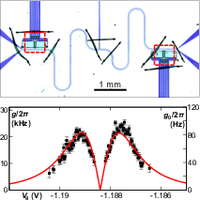
From this background we are excited to present a first optomechanical experiment where the motion of a suspended single carbon nanotube has been coupled to a superconducting coplanar microwave cavity; our work has been published in Nature Communications. Using the quantization of electric charge, we have been able to amplify the interaction between the two systems, vibration and electromagnetic field, by a factor 10000 compared to simple geometric predictions - and this is by far not the limit yet on what is achievable with our method. In addition, the coupling is controllable, and can be switched on and off quickly.
We obtain a so-called dispersively coupled optomechanical system - novel and exciting on one hand because of the miniaturization of the mechanical part and the coherent single electron effects, but well known on the other hand, since a huge body of theoretical and experimental research on larger (up to macroscopic scales) optomechanical systems exists. There, it has been shown that the coupling can be used for cooling of the vibration, for coherent amplification of signals, or even for arbitrary preparation of quantum states. Based on our results, also the quantum control of the string-like nanotube vibration will be reachable in the near future.

"Quantum capacitance mediated carbon nanotube optomechanics"
S. Blien, P. Steger, N. Hüttner, R. Graaf, and A. K. Hüttel
Nature Communications 11, 1636 (2020)

Monday, March 2, 2020

Visiting professor at Aalto University, absence from Regensburg

Since 15 February 2020, I have moved to Finland, following an invitation to the Department of Applied Physics, Aalto University as visiting professor. This is a great chance to make contacts and contribute to projects there, as well as to learn techniques and push our own project planning ahead.
For Regensburg this means that I am currently not accepting any students for thesis projects anymore, and that it may be quite difficult to find time for oral exams (like those "Modulprüfungen").

Monday, August 12, 2019

pssRRL accepted: Coulomb Blockade Spectroscopy of a MoS2 Nanotube

We are happy to be able to announce that our manuscript "Coulomb Blockade Spectroscopy of a MoS2 Nanotube" has been accepted for publication by pssRRL Rapid Research Letters.

Everybody is talking about novel semiconductor materials, and in particular the transition metal dichalcogenides (TMDCs), "layer materials" similar to graphene. With a chemical composition of TX2, where the transition metal T is, e.g., tungsten W or molybdenum Mo, and the chalcogenide X is, e.g., sulphur S or selenium Se, a wide range of interesting properties is expected.

What's by far not so well known is that many of these materials also form  nanotubes, similar to carbon nanotubes in structure but with distinct properties inherited from the planar system. Here, we present first low temperature transport measurements on a quantum dot in a MoS2 nanotube. The metallic contacts to the nanotube still require a lot of improvements, but the  nanotube between them acts as clean potential well for electrons.

Also, our measurements show possible traces of quantum confined behaviour. This is something that has not been achieved yet in planar, lithographically designed devices - since these have by their very geometric nature larger length scales. It means that via transport spectroscopy we can learn about the material properties and its suitability for quantum electronics devices.

A lot of complex physical phenomena have been predicted for MoS2, including spin filtering and intrinsic, possibly topologic superconductivity - a topic of high interest for the quantum computing community, where larger semiconductor nanowires are used at the moment. So this is the start of an exciting project!

"Coulomb Blockade Spectroscopy of a MoS2 Nanotube"
S. Reinhardt, L. Pirker, C. Bäuml, M. Remskar, and A. K. Hüttel
Physica Status Solidi RRL, doi:10.1002/pssr.201900251 (2019); arXiv:1904.05972 (PDF)

Tuesday, July 2, 2019

Where's the best sciences research in Germany? Here in Regensburg!

The Nature Index 2019 Annual Tables have been published, and there is a valuable new addition: the tables now include a "normalized ranking", where the quality of a university's research output, and not its quantity counts. If we look at the world-wide natural sciences ranking, University of Regensburg is at spot 44, best of all universities in Germany, and in a similar ranking range as, e.g., University of Oxford, University of Tokyo, or University of California San Francisco! Cheers and congratulations!

Thursday, May 2, 2019

Lecture announcement: High Frequency Engineering for Physicists

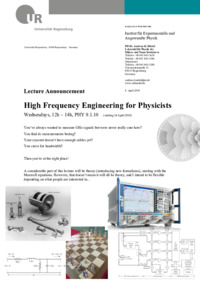
Term has already started, so this announcement is technically a bit late, however... This summer term I'm offering a lecture "High Frequency Engineering for Physicists". If you plan to work with signals in the frequency range 10MHz - 50GHz, this might be interesting for you...

When and where? Wednesdays, 12h - 14h, seminar room PHY 9.1.10. The next lecture is on 8 May 2019
  • Concepts and formalisms for the frequency range 10MHz - 50GHz
  • Handling equipment for this frequency range, designing devices and measurements
  • Using this frequency range in a (millikelvin) cryostat
More information can be found soon on the homepage of the lecture.

See you next wednesday!

Tuesday, April 30, 2019

Wednesday, February 27, 2019

PRL published: Shaping electron wave functions in a carbon nanotube with a parallel magnetic field

We're happy to announce that our manuscript "Shaping electron wave functions in a carbon nanotube with a parallel magnetic field" has been published as Editor's Suggestion in Physical Review Letters.

When a physicist thinks of an electron confined to a one-dimensional object such as a carbon nanotube, the first idea that comes to mind is the „particle in a box“ from elementary quantum mechanics. A particle can behave as a wave, and in this model it is essentially a standing wave, reflected at two infinitely high, perfect barrier walls. The mathematical solutions for the wave function describing it are the well-known half-wavelength resonator solutions, with a fundamental mode where exactly half a wavelength fits between the walls, a node of the wave function at each wall and an antinode in the center.

In this publication, we show how wrong this first idea can be, and what impact that has. In a carbon nanotube as quasi one-dimensional system, an electron is not in free space, but confined to the lattice of carbon atoms which forms the nanotube walls. This hexagonal lattice, the same that also forms in planar form graphene, is called bipartite, since every elementary cell of the lattice contains two carbon atoms; one can imagine the nanotube wall as being built out of two sub-lattices, with one atom per cell each, that are shifted relative to each other. Surprisingly, the hexagonal bipartite lattice does not generally support the half-wavelength solutions mentioned above, where the electronic wave function becomes zero at the edges. In each sublattice, we can only force the wave function to zero at one end of the nanotube "box"; its value at the other end remains finite. This means that the wave function shape for each of the two sublattices is more similar to that of a quarter wavelength resonator, where one end displays a node, the other an antinode. The two sublattice wave functions are mirrored in shape to each other, with node and antinode swapping position.

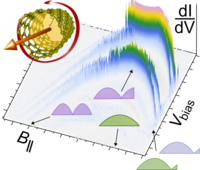
When we now apply a magnetic field along the carbon nanotube, a magnetic flux enters the nanotube, and the boundary conditions for the electron wave function change via the Aharonov-Bohm effect. Astonishingly, its shape along the carbon nanotube can thereby be tuned between half-wavelength and quarter-wavelength behaviour. This means that the probability of the trapped electron to be near the contacts changes, and with it the tunnel current, leading to a very distinct behaviour of the electronic conductance. It turns out that our measurement and the corresponding calculations are agreeing very well. Thus, our work shows the impact of a non-trivial host crystal on the electronic behaviour, important for many novel types of material.

"Shaping electron wave functions in a carbon nanotube with a parallel magnetic field"
M. Marganska, D. R. Schmid, A. Dirnaichner, P. L. Stiller, Ch. Strunk, M. Grifoni, and A. K. Hüttel
Physical Review Letters 122, 086802 (2019), Editor's Suggestion; arXiv:1712.08545 (PDF, supplementary information)

Thursday, October 18, 2018

Comp. Phys. Comm. published: "Lab::Measurement - a portable and extensible framework for controlling lab equipment and conducting measurements"

We're happy to announce that our article "Lab::Measurement — a portable and extensible framework for controlling lab equipment and conducting measurements", describing our measurement software package Lab::Measurement, has been published in Computer Physics Communications.

Lab::Measurement is a collection of object-oriented Perl 5 modules for controlling lab instruments, performing measurements, and recording and plotting the resultant data. Its operating system independent driver stack makes it possible to use nearly identical measurement scripts both on Linux and Windows. Foreground operation with live plotting and background operation for, e.g., process control are supported. For more details, please read our article, visit the Lab::Measurement homepage, or visit Lab::Measurement on CPAN!

"Lab::Measurement - a portable and extensible framework for controlling lab equipment and conducting measurements"
S. Reinhardt, C. Butschkow, S. Geissler, A. Dirnaichner, F. Olbrich, C. Lane, D. Schröer, and A. K. Hüttel
Comp. Phys. Comm. 234, 216 (2019); arXiv:1804.03321 (PDF)

Friday, May 18, 2018

PRL accepted: Nanomechanical characterization of the Kondo charge dynamics in a carbon nanotube

Today's great news is that our manuscript "Nanomechanical characterization of the Kondo charge dynamics in a carbon nanotube" has been accepted for publication by Physical Review Letters.

The Kondo effect is a many-body phenomenon at low temperature that results from a quantum state degeneracy, as, e.g., the one of spin states in absence of a magnetic field. In its simplest case, it makes a quantum dot, in our case a carbon nanotube with some trapped electrons on it, behave very different for an even and an odd number of electrons. At an even number of trapped electrons, no current can flow through the nanotube, since temperature and applied bias voltage are too low to charge it with one more elementary charge; this phenomenon is called Coulomb blockade. Strikingly, at odd electron number, when two degenerate quantum states in the nanotube are available, Coulomb blockade seems not to matter, and a large current can flow. Theory explains this by assuming that a localized electron couples to electrons in the contacts, forming a combined, delocalized singlet quantum state.
What carries the Kondo-enhanced current, and how does the electric charge now accumulate in the carbon nanotube? We use the vibration of the macromolecule to measure this. As also in the case of, e.g., a guitar string, the resonance frequency of a nanotube changes when you pull on it; in the case of the carbon nanotube this is sensitive enough to resolve fractions of the force caused by a single elementary charge. From the vibration frequency, as function of the electrostatic potential, we calculate the average number of electrons on the nanotube, and can then compare the odd and even number cases.
A surprising result of our evaluation is that the charge trapped on the nanotube behaves the same way in the even and odd occupation case, even though the current through it is completely different. Sequential tunneling of electrons can model the charge accumulation, and with it the mechanical behaviour. The large Kondo current is carried by virtual occupation of the nanotube alone, i.e., electrons tunneling on and immediately off again so they do not contribute to the charge on it.

"Nanomechanical Characterization of the Kondo Charge Dynamics in a Carbon Nanotube"
K. J. G. Götz, D. R. Schmid, F. J. Schupp, P. L. Stiller, Ch. Strunk, and A. K. Hüttel
Physical Review Letters 120, 246802 (2018); arXiv:1802.00522 (PDF, HTML, supplementary information)

Monday, January 8, 2018

FOSDEM 2018 talk: Perl in the Physics Lab

FOSDEM 2018, the "Free and Open Source Developers' European Meeting", takes place 3-4 February at Universite Libre de Bruxelles, Campus Solbosch, Brussels - and our measurement control software Lab::Measurement will be presented there in the Perl devrooom! As all of FOSDEM, the talk will also be streamed live and archived; more details on this follow later. Here's the abstract:
Perl in the Physics Lab
Andreas K. Hüttel
    Track: Perl Programming Languages devroom
    Room: K.4.601
    Day: Sunday
    Start: 11:00
    End: 11:40 
Let's visit our university lab. We work on low-temperature nanophysics and transport spectroscopy, typically measuring current through experimental chip structures. That involves cooling and temperature control, dc voltage sources, multimeters, high-frequency sources, superconducting magnets, and a lot more fun equipment. A desktop computer controls the experiment and records and evaluates data.

Some people (like me) want to use Linux, some want to use Windows. Not everyone knows Perl, not everyone has equal programming skills, not everyone knows equally much about the measurement hardware. I'm going to present our solution for this, Lab::Measurement. We implement a layer structure of Perl modules, all the way from the hardware access and the implementation of device-specific command sets to high level measurement control with live plotting and metadata tracking. Current work focuses on a port of the entire stack to Moose, to simplify and improve the code.

FOSDEM

Monday, May 8, 2017

Upcoming talk in the Regensburg physics colloquium

If you're in Regensburg, please come to the physics colloquium next week (15.5., 16:00st, lecture hall H34)! See the linked PDF for the full talk announcement.

"Millikelvin transport experiments on carbon nanotubes - nanoelectromechanics, spectroscopy, and more"