 PDF SVG |
 PDF SVG |
Saturday, January 30, 2016
Gentoo at FOSDEM: Posters (systemd, arches)
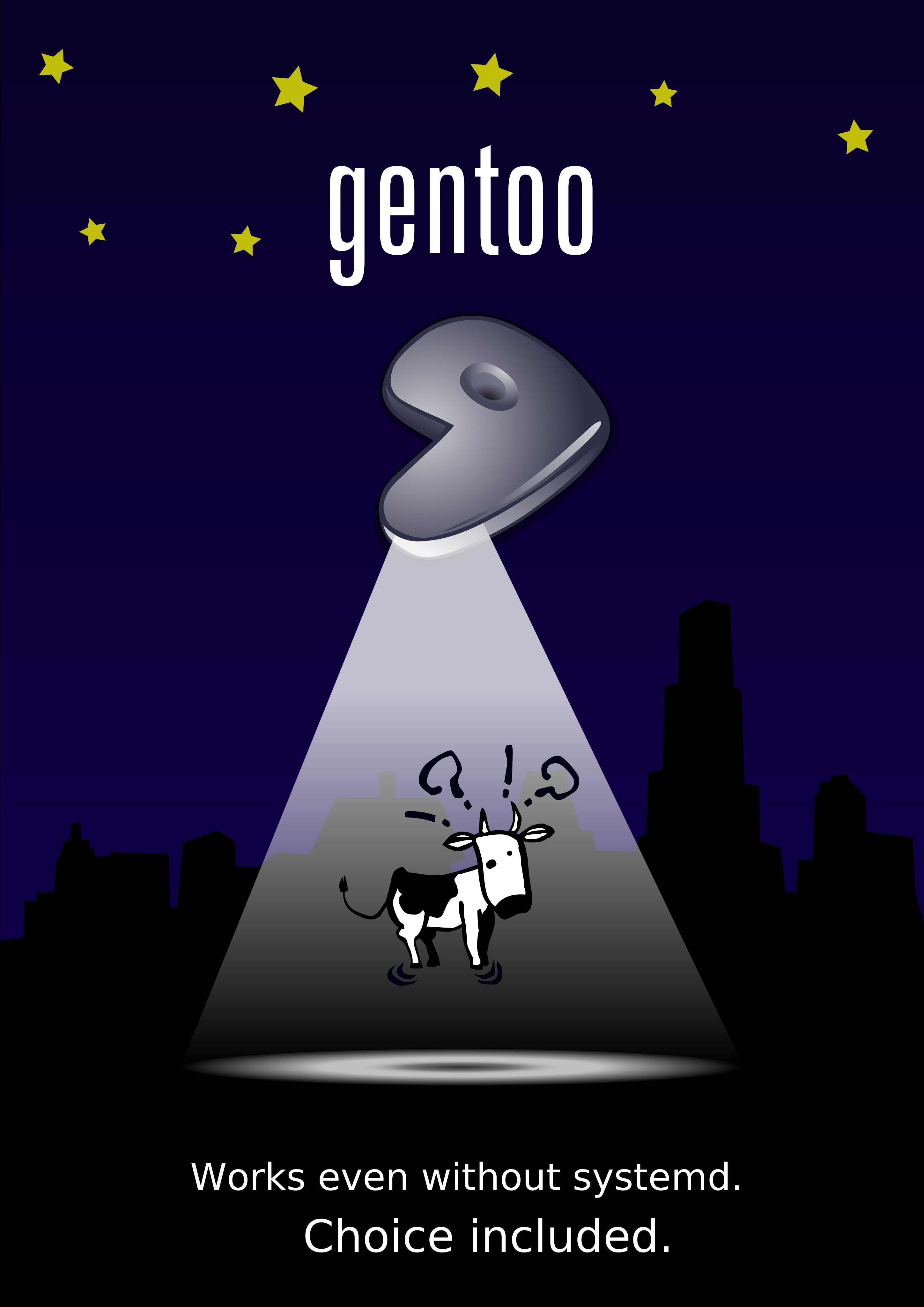
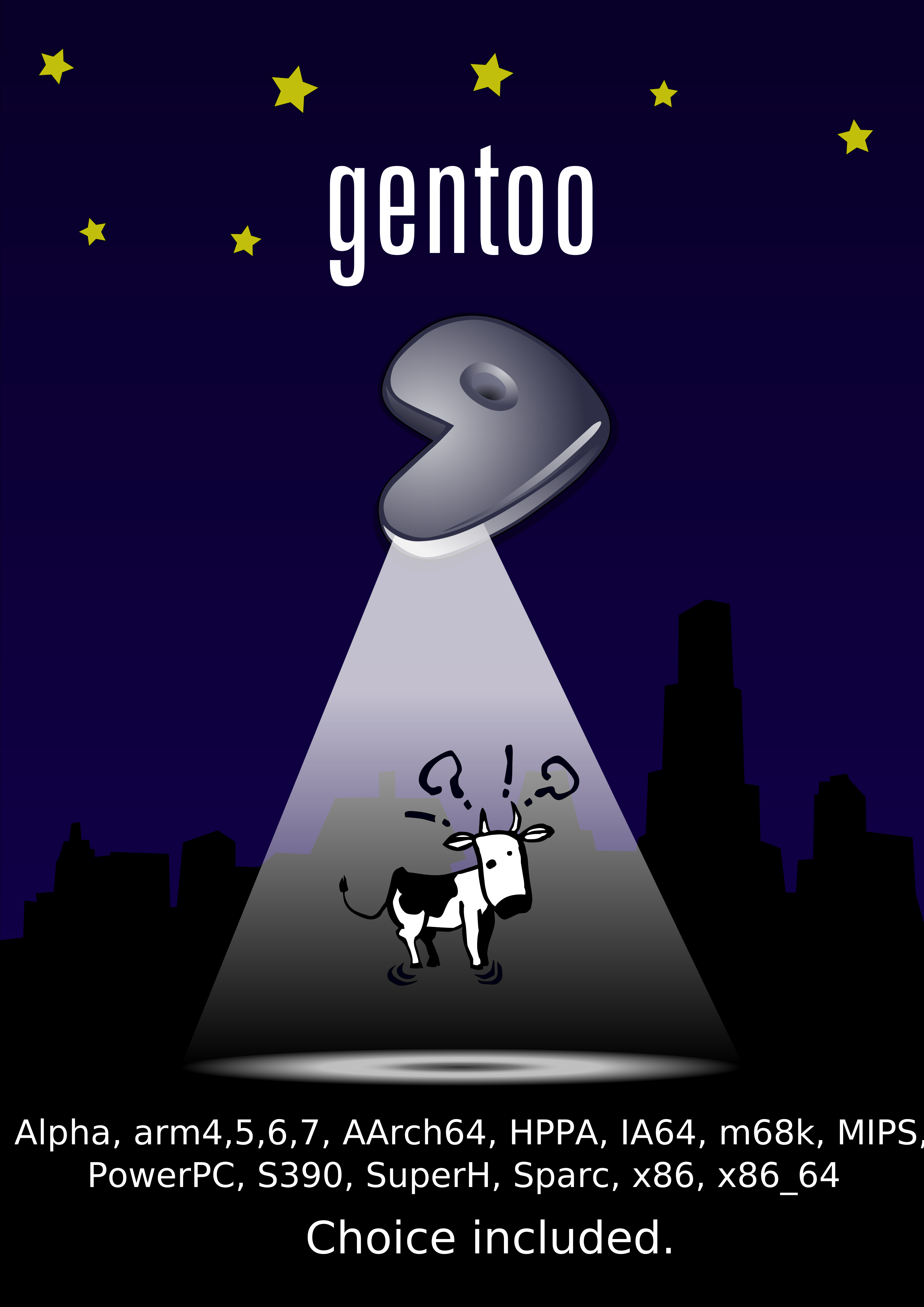
Especially after Lennart Poettering made some publicity for Gentoo Linux in his keynote talk (unfortunately I missed it due to other commitments :), we've had a lot of visitors at our FOSDEM booth. So, because of popular demand, here are again the files for our posters. They are based on the great "Gentoo Abducted" design by Matteo Pescarin. Released under CC BY-SA 2.5 as the original. Enjoy!

Tuesday, January 26, 2016
DFG magazine "german research" publishes article about our research group

"Carbon Nanotubes: Strong, Conductive and Defect-Free"
Carbon nanotubes are a fascinating material. In experiments at ultra-low temperatures, physicists make their different properties interact with one another - and in so doing find answers to fundamental questions.
Andreas K. Hüttel
german research 3/2015, 24-27 (2015) (PDF)
Friday, January 22, 2016
Please test www-apache/mod_perl-2.0.10_pre201601
We're trying to get both Perl 5.22 and Apache 2.4 stable on Gentoo these days. One thing that would be really useful is to have a www-apache/mod_perl that works with all current Perl and Apache versions... and there's a candidate for that: a snapshot of what is hopefully going to be mod_perl-2.0.10 pretty soon. So...
Please keyword (if necessary) and test www-apache/mod_perl-2.0.10_pre201601!!! Feedback for all Perl and Apache versions is very much appreciated. Gentoo developers can directly edit our compatibility table with the results, everyone else please comment on this blog post or file bugs in case of problems!
Please always include exact www-servers/apache, dev-lang/perl, and www-apache/mod_perl versions!
Please keyword (if necessary) and test www-apache/mod_perl-2.0.10_pre201601!!! Feedback for all Perl and Apache versions is very much appreciated. Gentoo developers can directly edit our compatibility table with the results, everyone else please comment on this blog post or file bugs in case of problems!
Please always include exact www-servers/apache, dev-lang/perl, and www-apache/mod_perl versions!
Friday, November 27, 2015
Grafting history onto your Gentoo git clone
Somehow after a while I got a bit tired that my git checkout of the main Gentoo repository didn't have any real history available. So, here's how I got it back:
(Note, you may want a fast network connection for this.)
Should at some point in the future a new, improved (or "official") conversion of the cvs history become available, here's (untested) what to do:
Thanks to rich0 for providing the draft conversion (though inofficial so far) and to everyone else involved.
(Note, you may want a fast network connection for this.)
- cd into the main directory of the Gentoo git checkout:
$ cd ~/Gentoo/gentoo
- fetch 2GByte of converted cvs history into a new local branch "history-20150809-draft"
$ git fetch https://github.com/gentoo/gentoo-gitmig-20150809-draft.git master:history-20150809-draft
- attach the last commit of the cvs history to the first commit of the new git era
$ echo 56bd759df1d0c750a065b8c845e93d5dfa6b549d 2ebda5cd08db6bdf193adaa6de33239a83a73af0 > .git/info/graftsAnd done. :)
Should at some point in the future a new, improved (or "official") conversion of the cvs history become available, here's (untested) what to do:
- fetch it in the same way into a new local cvs history branch, and
- modify the grafts file to now connect the last commit of the new local cvs history branch with the first commit of the git era.
Thanks to rich0 for providing the draft conversion (though inofficial so far) and to everyone else involved.
Monday, September 14, 2015
APL accepted: Liquid-induced damping of mechanical feedback effects in single electron tunneling through a suspended carbon nanotube

One of the surprises that suspended, clean carbon nanotubes have in store is that they can start vibrating strongly at millikelvin temperatures without any applied radio-frequency driving signal. This was proposed theoretically several years ago by Usmani et al., as a strong feedback between the transversal vibration of the nanotube and the single electron tunneling through it. The effect was identified in measurements, and for example in a previous publication we have shown that damping induced by a magnetic field can suppress it.
Here, we demonstrate how one and the same device behaves distinctly different depending on the environment medium (or lack of the latter): we compare measurements made at the same temperature in a conventional dilution refrigerator, where the chip is placed into a vacuum chamber, and in a so-called top-loading dilution refrigerator, where the chip is inserted into the 3He/4He liquid of the mixing chamber. The overall electronic properties of the device do not change much, even though the thermal cycling could cause a lot of damage and has done so in the past for other devices. We can here even extract a rough estimate of the liquid helium dielectric constant by comparing the slightly shifted Coulomb oscillation positions of the two measurements.
However, a striking difference appears when looking at finite bias conductance and the mechanical feedback effects. In the viscous helium liquid, the resonator is damped and the vibrations are suppressed, and the unperturbed electronic transport spectrum emerges. Such an inert, liquid environment can thus be used to do transport spectroscopy at high transparency of the tunnel barriers and high applied bias voltages - parameter regions interesting for e.g. non-equilibrium Kondo phenomena, where otherwise mechanically-induced features would make data evaluation highly challenging.
"Liquid-induced damping of mechanical feedback effects in single electron tunneling through a suspended carbon nanotube"
D. R. Schmid, P. L. Stiller, Ch. Strunk, and A. K. Hüttel
Applied Physics Letters 107, 123110 (2015); arXiv:1407.2114 (PDF)
Monday, July 20, 2015
VMware Workstation 11 and kwin - hangs and hiccups (solved?)
Since updating to VMware Workstation 11 (from the Gentoo vmware overlay), I've experienced a lot of hangs of my KDE environment whenever a virtual machine was running. Basically my system became unusable, which is bad if your workflow depends on accessing both Linux and (gasp!) Windows 7 (as guest). I first suspected a dbus timeout (doing the "stopwatch test" for 25s waits), but it seems according to some reports that this might be caused by buggy behavior in kwin (4.11.21). Sadly I haven't been able to pinpoint a specific bug report.
Now, I'm not sure if the problem is really 100% fixed, but at least now the lags are much smaller- and here's how to do it (kudos to matthewls and vrenn):
Now, I'm not sure if the problem is really 100% fixed, but at least now the lags are much smaller- and here's how to do it (kudos to matthewls and vrenn):
- Add to /etc/xorg.conf in the Device section
Option "TripleBuffer" "True"
- Create a file in /etc/profile.d with content
__GL_YIELD="USLEEP"
(yes that starts with a double underscore). - Log out, stop your display manager, restart it.
Friday, July 3, 2015
KDEPIM without Akonadi
As you know, Gentoo is all about flexibility. You can run bleeding edge code (portage, our package manager, even provides you with installation from git master KF5 and friends) or you can focus on stability and trusted code. This is why we've been offering our users for the last years KDEPIM 4.4.11.1 (the version where KMail e-mail storage was not integrated with Akonadi yet, also known as KMail1) as a drop-in replacement for the newer versions.
Recently the Nepomuk search framework has been replaced by Baloo, and after some discussion we decided that for the Nepomuk-related packages it's now time to go. Problem is, the old KDEPIM packages still depend on it via their Akonadi version. This is why - for those of our users who prefer to run KDEPIM 4.4 / KMail1 - we've decided to switch to Pali Rohár's kdepim-noakonadi fork (see also his 2013 blog post and the code).The packages are right now in the KDE overlay, but will move to the main tree after a few days of testing and be treated as an update of KDEPIM 4.4.11.1.
The fork is essentially KDEPIM 4.4 including some additional bugfixes from the KDE/4.4 git branch, with KAddressbook patched back to KDEPIM 4.3 state and references to Akonadi removed elsewhere. This is in some ways a functionality regression since the integration of e.g. different calendar types is lost, however in that version it never really worked perfectly anyway.
For now, you will still need the akonadi-server package, since kdepimlibs (outside kdepim and now at version 4.14.9) requires it to build, but you'll never need to start the Akonadi server. As a consequence, Nepomuk support can be disabled everywhere, and the Nepomuk core and client and Akonadi client packages can be removed by the package manager (--depclean, make sure to first globally disable the nepomuk useflag and rebuild accordingly).
You might ask "Why are you still doing this?"... well. I've been told Akonadi and Baloo is working very nicely, and again I've considered upgrading all my installations... but then on my work desktop where I am using newest and greatest KDE4PIM bug 338658 pops up regularly and stops syncing of important folders. I just don't have the time to pointlessly dig deep into the Akonadi database every few days. So KMail1 it is, and I'll rather spend some time occasionally picking and backporting bugfixes.
Recently the Nepomuk search framework has been replaced by Baloo, and after some discussion we decided that for the Nepomuk-related packages it's now time to go. Problem is, the old KDEPIM packages still depend on it via their Akonadi version. This is why - for those of our users who prefer to run KDEPIM 4.4 / KMail1 - we've decided to switch to Pali Rohár's kdepim-noakonadi fork (see also his 2013 blog post and the code).The packages are right now in the KDE overlay, but will move to the main tree after a few days of testing and be treated as an update of KDEPIM 4.4.11.1.
The fork is essentially KDEPIM 4.4 including some additional bugfixes from the KDE/4.4 git branch, with KAddressbook patched back to KDEPIM 4.3 state and references to Akonadi removed elsewhere. This is in some ways a functionality regression since the integration of e.g. different calendar types is lost, however in that version it never really worked perfectly anyway.
For now, you will still need the akonadi-server package, since kdepimlibs (outside kdepim and now at version 4.14.9) requires it to build, but you'll never need to start the Akonadi server. As a consequence, Nepomuk support can be disabled everywhere, and the Nepomuk core and client and Akonadi client packages can be removed by the package manager (--depclean, make sure to first globally disable the nepomuk useflag and rebuild accordingly).
You might ask "Why are you still doing this?"... well. I've been told Akonadi and Baloo is working very nicely, and again I've considered upgrading all my installations... but then on my work desktop where I am using newest and greatest KDE4PIM bug 338658 pops up regularly and stops syncing of important folders. I just don't have the time to pointlessly dig deep into the Akonadi database every few days. So KMail1 it is, and I'll rather spend some time occasionally picking and backporting bugfixes.
Subscribe to:
Posts (Atom)