Thursday, June 30, 2011
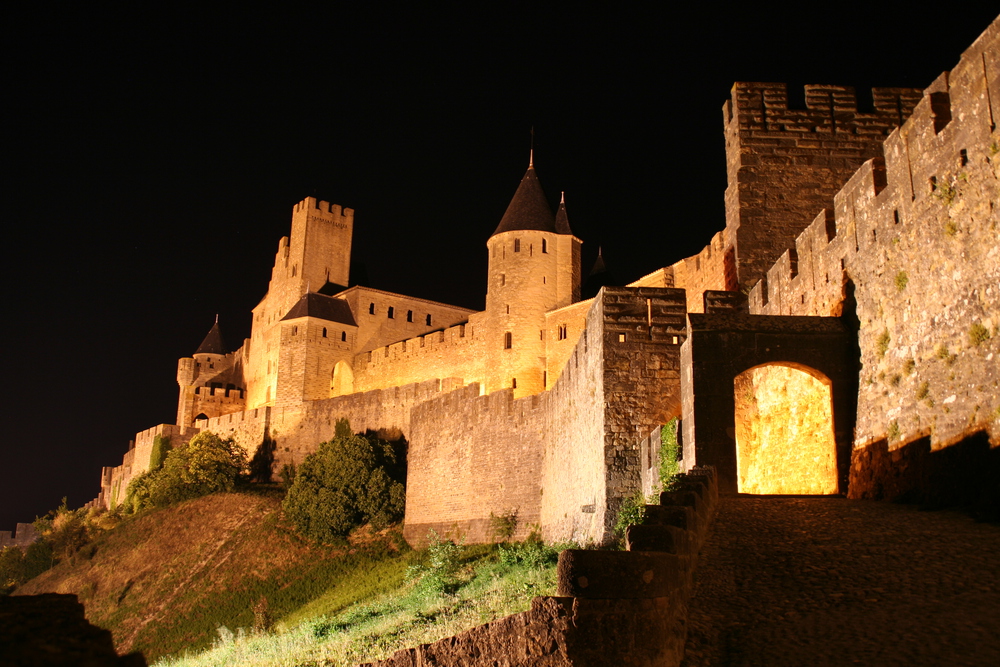
Carcassonne, the city from another world

Vacation reading: "Young Miles"
I'm on vacation... and while that often means I'm running around from romanesque monastery to roman rubble pile, this time it's also a real relaxation vacation. Including beaches and many shady cafes in beautiful old cities (have I mentioned Carassonne already?). Time to slow down, go through the recommendations from friends collected throughout the last months and grab a good book (or two, or three). I started of with "Young Miles", and what a strange start it was...
 "It isn't easy, being a Vor lord..." Miles Vorkosigan, age 17, is only son of the emperor's regent and heir to an ancient title himself. Life could be perfect, were it not for that unfortunate assassination attempt on his parents years ago, which left him, err, vertically challenged for life, and with rather brittle bones. When your predestined career is the military, this does not really help... especially if you fail the entrance physical by breaking both legs at the first hurdle of the obstacle course. This, however, is where the story only starts. Our hero is gifted with ego, brains, and a not-just-slightly hyper attitude to bounce from one improbable situation into the next, collecting friends, allies, enemies, and a most crazy storyline. Of course, his adventures include all the things that real academy cadets are told never to expect (even in imperial security, you'll only ever meet ugly male spies), and the chain of command is not really a suitable concept for a little egomaniac like Miles. Kept me laughing for quite some time, and I will have a look at the many already existing sequels sometime soon.
A friend recommended the book to me with the words "like Tyrion Lannister from Game of Thrones, with less daddy issues and prostitutes", but that comparison is missing a few points. Not as deep as Game of Thrones and not as elaborate, but very much fun relaxation reading. It's a bit like going from Lord of the Rings to the early, light-hearted Harry Potters, and mixing in a dose of Stephanie Plum... :) Oh yeah, and don't get turned off by the book cover. Other people find it strange too and have made way better suggestions...
Lois McMaster Bujold, "Young Miles". Baen Books 2003; ISBN 0-7434-3616-4. Buffo space opera, screwball sci-fi comedy. 4 out of 5 smileys in the Light Reading category :))))!

A friend recommended the book to me with the words "like Tyrion Lannister from Game of Thrones, with less daddy issues and prostitutes", but that comparison is missing a few points. Not as deep as Game of Thrones and not as elaborate, but very much fun relaxation reading. It's a bit like going from Lord of the Rings to the early, light-hearted Harry Potters, and mixing in a dose of Stephanie Plum... :) Oh yeah, and don't get turned off by the book cover. Other people find it strange too and have made way better suggestions...
Lois McMaster Bujold, "Young Miles". Baen Books 2003; ISBN 0-7434-3616-4. Buffo space opera, screwball sci-fi comedy. 4 out of 5 smileys in the Light Reading category :))))!
Saturday, June 18, 2011
A "new" CUPS is coming your way...
It's taken some time, but finally CUPS-1.4, a "new" major release of "the standards-based, open source printing system developed by Apple Inc. for Mac OS® X and other UNIX®-like operating systems", will be arriving for our stable users in the near future. The arch teams are testing, see bug 333781 for the details and progress.
So what does that mean? Well, technically there are a lot of new features since CUPS-1.3. In practice, I hope that some of the ancient Gentoo bugs like #341127 or #349496 go away now, since finally CUPS supports some of the features that modern desktop environments require. Also, right now CUPS is an embarrassing security hole, which will also be fixed by the upgrade.
In the version about to be stabilized, we do not support the new libusb-based interface for USB printers yet. Accessing USB printers will be done via the USB printer functionality in the kernel, as in CUPS-1.3. Why? Simply because there are still way too many problems with it. If you want to give it a try anyway, just keyword net-print/cups-1.4.6-r21 - the only difference between -r2 (the stable candidate) and -r21 is that -r21 supports the libusb backend with the usb use-flag. Cheers!
So what does that mean? Well, technically there are a lot of new features since CUPS-1.3. In practice, I hope that some of the ancient Gentoo bugs like #341127 or #349496 go away now, since finally CUPS supports some of the features that modern desktop environments require. Also, right now CUPS is an embarrassing security hole, which will also be fixed by the upgrade.
In the version about to be stabilized, we do not support the new libusb-based interface for USB printers yet. Accessing USB printers will be done via the USB printer functionality in the kernel, as in CUPS-1.3. Why? Simply because there are still way too many problems with it. If you want to give it a try anyway, just keyword net-print/cups-1.4.6-r21 - the only difference between -r2 (the stable candidate) and -r21 is that -r21 supports the libusb backend with the usb use-flag. Cheers!
Friday, June 3, 2011
NI-VISA final fail
In a previous blog post, I already pointed out that using the NI-VISA library to control lab devices with Linux is becoming more and more painful - especially when you heavily rely on National Instrument's high speed USB-GPIB adapters. But hey, supporting kernels newer than 2.6.24 is luxury anyway, right?
Yesterday I tried to update my "test box" for Linux lab software, just in case I can maybe convince one of my colleagues to work with that strange OS for a change. Then, I realized that for us the NI-VISA package has finally become totally useless:
The age-old kernel requires old udev (<=142 if I remember correctly), which I enforced with a package.mask and now is incompatible with other recent stuff. Ah well... >:| no more VISA on Linux for us.
Yesterday I tried to update my "test box" for Linux lab software, just in case I can maybe convince one of my colleagues to work with that strange OS for a change. Then, I realized that for us the NI-VISA package has finally become totally useless:
(meas) pc5xxxx ~ # emerge -uDNav --keep-going world
Performing Global Updates:
(Could take a couple of minutes if you have a lot of binary packages.)
.='update pass' *='binary update' #='/var/db update' @='/var/db move'
s='/var/db SLOT move' %='binary move' S='binary SLOT move'
p='update /etc/portage/package.*'
/var/lib/layman/n4g/profiles/updates/4Q-2009..........
These are the packages that would be merged, in order:
Calculating dependencies... done!
!!! All ebuilds that could satisfy ">=sys-fs/udev-151[extras]" have been masked.
!!! One of the following masked packages is required to complete your request:
- sys-fs/udev-9999 (masked by: package.mask, missing keyword)
- sys-fs/udev-168-r2 (masked by: package.mask, ~x86 keyword)
- sys-fs/udev-168-r1 (masked by: package.mask, ~x86 keyword)
- sys-fs/udev-168 (masked by: package.mask, ~x86 keyword)
- sys-fs/udev-167-r1 (masked by: package.mask, ~x86 keyword)
- sys-fs/udev-167 (masked by: package.mask, ~x86 keyword)
- sys-fs/udev-164-r2 (masked by: package.mask, ~x86 keyword)
- sys-fs/udev-164-r1 (masked by: package.mask, ~x86 keyword)
- sys-fs/udev-164 (masked by: package.mask, ~x86 keyword)
- sys-fs/udev-163 (masked by: package.mask, ~x86 keyword)
- sys-fs/udev-162 (masked by: package.mask, ~x86 keyword)
- sys-fs/udev-151-r4 (masked by: package.mask)
(dependency required by "sys-power/upower-0.9.9" [ebuild])
(dependency required by "kde-base/kdelibs-4.6.2-r3" [ebuild])
(dependency required by "kde-base/khelpcenter-4.6.2" [ebuild])
For more information, see the MASKED PACKAGES section in the emerge
man page or refer to the Gentoo Handbook.
(meas) pc5xxxx ~ #
The age-old kernel requires old udev (<=142 if I remember correctly), which I enforced with a package.mask and now is incompatible with other recent stuff. Ah well... >:| no more VISA on Linux for us.
Tuesday, May 17, 2011
A letter for a lot of money

Our research is focussing on electronic and mechanical processes at extremely low temperatures. "Extremely low" means in that case something like 20mK, or 0.02 degrees above absolute zero, or -272.95°C. To reach such temperatures, several steps of cooling have to be employed. First, the entire experimental assembly is submerged in a dewar (something like a thermos flask) filled with liquid helium, boiling away at 4.2K. Then, inside another vacuum chamber, evaporation cooling with again liquid helium is used to lower the temperature even further to somewhere around 1.5K. Lastly a closed cooling cycle with a mixture of the two isotopes of helium, helium-3 and helium-4, is used to lower the temperature even further to the base temperature of 0.02K. This entire machinery is called a dilution refrigerator; it was invented in 1951, and is by now available commercially from several companies worldwide.
So what happened today? Well, after getting a grant for buying one of them beasties, writing up the specifications, starting the Europe-wide call for tenders, awaiting and carefully evaluating the quotes, finally I've sent off the decision letter. "Please buy this one." Phew. I hope all works out, this thing costs about as much as a top-range Ferrari...
Saturday, May 14, 2011
Hunting the glib-networking / libproxy mystery bug
Just when we wanted to stabilize KDE-4.6, an unpleasant surprise appeared out of nowhere. For no apparent reason, polkit was failing to make DBUS connections. As one consequence, some users could not log into KDE; the desktop would simply hang during the session initialization. After upgrading and downgrading packages, and after a lot of communication on bugzilla (since noone from the Gentoo KDE team could reproduce the bug), a pattern emerged: net-libs/glib-networking-2.28.6.1 was somehow causing the problem, force-unmerging it with "emerge -C" restored correct behaviour. Later, this was narrowed down to net-libs/glib-networking[libproxy].
Minus docs and debug info, this is what is installed by glib-networking:
cause DBUS hangs. Let's just say, the Gnome guys did not know either, but obviously the most intrusive part is the proxy autoconfiguration service registered in dbus.
As KDE-4.6.2 stabilization was pending, one way to temporarily get around the problem was to block concurrent installation of net-libs/glib-networking[libproxy]. After all that package appeared only on 24 Apr 2011 (one week before the bug report was filed) as ~arch in the main tree, and is hard-required in exactly one package (net-voip/telepathy-gabble). Yes, we checked that thoroughly before. User responses however were not so, err, welcoming.
Minus docs and debug info, this is what is installed by glib-networking:
/usr/lib/gio/modules/libgiolibproxy.soWhich leads to the question, how can these seemingly unrelated libraries
/usr/lib/gio/modules/libgiognutls.so
/usr/lib/gio/modules/libgiognomeproxy.so
/usr/share/dbus-1/services/org.gtk.GLib.PACRunner.service
/usr/libexec/glib-pacrunner
cause DBUS hangs. Let's just say, the Gnome guys did not know either, but obviously the most intrusive part is the proxy autoconfiguration service registered in dbus.
As KDE-4.6.2 stabilization was pending, one way to temporarily get around the problem was to block concurrent installation of net-libs/glib-networking[libproxy]. After all that package appeared only on 24 Apr 2011 (one week before the bug report was filed) as ~arch in the main tree, and is hard-required in exactly one package (net-voip/telepathy-gabble). Yes, we checked that thoroughly before. User responses however were not so, err, welcoming.
"Anyway it is high time ppl start thinking before committing any changes in the main tree... even if we are talking about an unstable ~ stuff..." (bug 365479, comment 38)Ah well. Now the blocker is gone again and we won't hinder people from shooting themselves in the foot, but we still dont know what actually the problem is. In any case, libproxy seems to be prone to more misbehaviour (what the %$&%$ is it doing in NVidia OpenGL code??!!). So far the reports of various details do not really add up to a coherent picture.
"Now we have repeat with strange blocker... and all because some guy forgotten (or didnt want to) try it before pushing into tree... Sometimes i think that Gentoo developers comes from the round-up." (bug 365479, comment 43)
Saturday, April 30, 2011
Finished something, finally
The last weeks were actually a busy time for several reasons. Well, there's one less now: at work, yesterday Friday evening at around 21:00 I finally submitted a manuscript (5Mbyte pdf) for publication that we have been preparing for ages.
The whole story started with measurements done in our lab last year, where we look among other things at electrical currents through single carbon nanotubes at very low temperatures of a few millidegrees above absolute zero. In this particular case, the metallic contacts to the nanotube were made of a magnetic PdNi alloy, which means that you have to take into account the magnetic moment (the spin) of the electrons in the contacts and of the electrons passing through the nanotube. Models for such systems have been developed and measurements done for some time already, but together with our theory colleagues from Chonnam, Poznan, and München we have shown for the first time that even quantitatively these models can be reduced to the non-magnetic case with a rather straightforward transformation, and that still the calculations fit the data very well. That is a pretty nice result, since for the emerging technology field of spintronics control of all these current transport effects is quite important.
Now it's time for new projects (and for awaiting the referee reports)...
The whole story started with measurements done in our lab last year, where we look among other things at electrical currents through single carbon nanotubes at very low temperatures of a few millidegrees above absolute zero. In this particular case, the metallic contacts to the nanotube were made of a magnetic PdNi alloy, which means that you have to take into account the magnetic moment (the spin) of the electrons in the contacts and of the electrons passing through the nanotube. Models for such systems have been developed and measurements done for some time already, but together with our theory colleagues from Chonnam, Poznan, and München we have shown for the first time that even quantitatively these models can be reduced to the non-magnetic case with a rather straightforward transformation, and that still the calculations fit the data very well. That is a pretty nice result, since for the emerging technology field of spintronics control of all these current transport effects is quite important.
Now it's time for new projects (and for awaiting the referee reports)...
Subscribe to:
Posts (Atom)